Friday, April 16, 2010

Mako Shark

The Mako Shark is a slender shaped shark with a long cone-like snout. This shark has short pectoral fins and a crescent shaped caudal (tail) fin. Its second dorsal fin is much smaller than the first. The teeth are are slender and slightly curved with no flat teeth, and are visible even when the mouth is closed. There is marked countershading on this shark: dorsally it is a metallic indigo blue while ventrally it is white.

The Mako Shark can grow to lengths of 3.9 meters (13 feet). There is still some uncertainty about its life-span, but it is suspected to reach ages of between 11-23 years. As one of the fastest sharks in the ocean, this powerful shark can attain burst swimming speeds of up to 22 mph and can leap clear of the water to heights of up to 20 feet. These qualities have made this species a sought after sport fish in some parts of its range.

The shortfin mako is found worldwide. In the western Atlantic it can be found from Argentina and the Gulf of Mexico to Browns Bank off of Nova Scotia. In Canadian waters these sharks are not abundant as they prefer warm waters. Makos are often found in the same waters as swordfish as they are a source of food and both fish prefer similar environmental conditions.

Saturday, April 3, 2010

Hawksbill Sea Turtle


The Hawksbill Sea Turtle is the number 7 endangered species on the top 10 list. Unfortunately, this animal follows a pattern that the other species on the list do as well. Its endangered status is mostly due to human involvement. Hawksbill eggs are still eaten around the world despite the turtle’s international protected status, and they are often killed for their flesh and their stunning shells. These graceful sea turtles are also threatened by accidental capture in fishing nets.
Like other sea turtles, hawksbills make incredible migrations in order to move from feeding sites to nesting grounds, normally on tropical beaches. Mating occurs every two to three years and normally takes place in shallow waters close to the shore. The nesting procedure begins when the turtles leave the sea to choose an area to lay their eggs. A pit is dug in the sand, filled with eggs, and then covered. At this stage the turtles retreat to the sea, leaving the eggs, which will hatch in about 60 days.The most dangerous time of their lives comes when hatchlings make the journey from their nests to the sea. Crabs and flocks of gulls voraciously prey on the young turtles during this short scamper.
They are normally found near reefs rich in the sponges they like to feed on. Hawksbills are omnivorous and will also eat mollusks, marine algae, crustaceans, sea urchins, fish, and jellyfish. Their hard shells protect them from many predators, but they still fall prey to large fish, sharks, crocodiles, octopuses, and most especially humans. The Hawksbill Sea Turtle is not a man-eating killer, or even a threat to society for that matter. So why do we as humans find it necessary to capture and kill these creatures that only add wonder to our planet?

Wednesday, March 24, 2010

Primates in Peril

Primates are human beings' closest living relative to date. So why is it that so many of our "ancestors" keep disappearing? And why our we, as human beings, responsible for their disappearance? The answer lies within a detailed journal article titled Primates in Peril. Primates are not the most common mammal to appear in conversation about endangered species. As humans we assume that primates are in no danger of extinction because of their close relation to us. When in actuality apes, gorillas, and humans are not the only mammals included in the category of primates. Other animals that make up the primate subgroup include lemurs, galagos, and tarsiers all ranging in size from a mouse lemur to a 400 pound gorilla. Now, you may be asking yourself, what is it exactly that is causing these primates to vanish?

Bush meat is meat that comes from animals killed in the wild. Unfortunately, this is one of the main causes for these creatures disappearance. In some parts of the world these primates are considered to be delicacies. Another main cause of endangerment is the lack of habitat as well as deforestation in the primates main dwelling space. These primates are even being killed for medicinal purposes, particularly in parts of Asia, and captured for exotic pet trade that prevents them from additional breeding in the wild.

So really why does it matter if our own kin was to disappear from the earth forever? To answer the question simply, it matters because it is our moral responsibility to keep alive the animals that inhabit this earth, especially our own relatives. Primates even play an important role in expanding and protecting forests around the world. They feed on many fruits, which in turn spreads seeds throughout the forest floor causing more growth and more expansion. Don't wait to take action to prevent our own relatives from disappearing from the face of the earth forever.

Saturday, March 20, 2010

The Tiger


Unfortunately, when it comes to endangered species, the tiger stands in the top five. When I say the tiger, I don't just mean the White Tiger, or the Indian Tiger, I mean the entire species of tigers. Newspapers such as the New York Times are speculating that the last years of the tiger is closer than we think. Experts and professionals are speculating that within the year of 2010, the population of wild tigers will dwindle to below 3,000 worldwide-less than 3% of what it was 100 years ago. Today, their range has been reduced to small areas, isolating many of the animals into impoverished groups of only a dozen or fewer cats.
Its sad when such a dominating animal's survival, such as the tiger's, is completely and utterly dependent on the help and intelligence of humans. Obviously, in strenth and physical size, the tiger is ultimately superior to humans. Unfortunately for the tigers, it is the fault of man kind only that keeps them at the number three spot on the endangered species list. We put them on the list, and now it is our own responsibility, as humans, to either save them from a terrible fate, or allow them to fade away into obscurity. Surprisingly, even the different tiger reserves stationed around the globe have arrived at the point where they no longer have any tigers to house. Mull that little fact over for a minute. A fact such as that gives you more of an ideal image of the epidemic the tiger faces in the very near future.
There is an estimated 5,000 captive tigers in China, and another 8,000 captive tigers worldwide. Most are mainly kept for exhibits, entertainment, pets, and even livestock. There is even one specific spot located somewhere in Texas, that houses more captive tigers in that one area than the wild tigers that still exist and walk the earth. Meanwhile, professionals and experts continue to talk about how to keep the biggest of big cats freely and happily roaming in a few small corners that are left on the planet.

Thursday, March 11, 2010

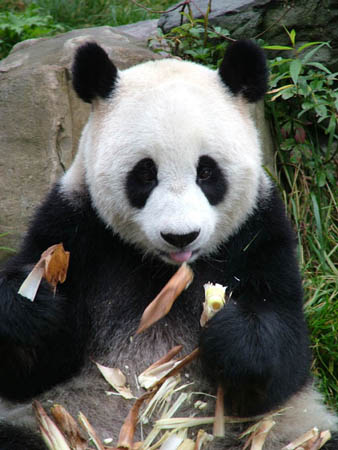
The Giant Panda


I have come to the conclusion that ulitmately the survival or extinction of an endangered species is on the shoulders of humanity. How sad is it when it is our own responsibility, as the human race, for the life or death of another living creature? We become so selfish in our own desires and material possessions that we become more worried about our hair color and when our next pedicure is scheduled. It is superficial thoughts and actions of all humanity, including myself, that ultimately endanger the precious animals that inhabit this earth.

It is animals such as the Giant Panda that come under attack from actions of humans. Great strides have been made within the last few years in an effort to conserve the Giant Panda. They inhabit many areas throughout China, but more specifically they live within the mountain ranges of central China. However, the Giant Panda's habitat is becoming less and less dense. The reason for this is mainly due to farming, forest clearing, and other developments caused by the human race. I came across a website, that gives any and every information about the Giant Panda and its involvement within the World Wildlife Federation.


The giant panda is listed as endangered in the World Conservation Union's (IUCN's) Red List of Threatened Animals. There are about 1,600 left in the wild. More than 160 pandas live in zoos and breeding centers around the world, mostly in China. Hopefully the Giant Panda never has to reach a state of extinction, and unfortunately their status in this world relies on us.

Thursday, March 4, 2010

The Black Rhino


As I continue in my research of endangered species, I think it would be beneficial to discuss the #1 animal on the list: The Black Rhino. I stumbled across a website entirely devoted to the subject of endangered and threatened animals. It offers every and any information you ever wanted to know about endangerment. There are specific sections including galleries, facts, and specific animal profiles. There are even sections discussing the laws that are protecting and keeping these animals alive. Kids sections as well as case studies done by zoologists are also available for view. The most interesting section, however, is the page devoted to the specific endangered and threatened animals in your specific state.

I particularly focused in on the page devoted to the Black Rhino, and why it is the number one endangered species on the planet. The Western African Black Rhino has unfortunately already been declared as extinct. However, there are still three other species of Black Rhino remaining. The main cause of death for these creatures is unfortunately due to poaching which is caused by the political instability in and around the areas where the rhinos reside. The Black Rhino has been listed as critically endangered since 2001, and as previously stated, there is no evidence that the Western African Black Rhino is still in existence. Black Rhinos are mainly hunted for their horns(which is made from the same material as our fingernails), which can be used to make cups, bowls, and even weapons such as daggers. Unfortunately many of the efforts made to decrease the poaching and stockpiles have been defeated.

With all this bad news, I am happy to report that many protective measures are being taken for the three remaining subspecies of the Black Rhino. Captive breeding for reintroduction is one of the many precautions taking place in order to prevent anything from happening to this creature again. International wildlife conservation groups continue to work to stop poaching activities in black rhino range states. These efforts and the involvement of local communities in protecting the black rhino and its habitat will be necessary if the remaining three subspecies are to avoid extinction.

Sunday, February 28, 2010

The Alligator Snapping Turtle

According to the World Wildlife Federation (WWF) the top ten most endangered species are as follows.

1. Black Rhino
2. Giant Panda
3. Tiger
4. Beluga Sturgeon
5. Goldenseal
6. Alligator Snapping Turtle
7. Hawksbill Turtle
8. Big Leaf Mahogany
9. Green-Cheeked Parrot
10. Mako Shark

The video that I have posted below is a clip from the Discovery Channel show "Dirty Jobs" and it focuses on the Alligator Snapping Turtle and its incredible jaw power. I picked this particular video because I personally find it fascinating that an animal with such a small and compact size (compared to many others) has the second strongest jaw of any other animal in the world and still remains an endangered species. I hope to get around to discussing and posting about the rest of the top ten endangered species and eventually maybe getting further down the list to some of the others.